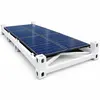
FAQs About Solar Platforms
Solar platforms are becoming an increasingly popular option for powering temporary worksite facilities, helping projects reduce fuel costs, lower emissions and improve sustainability performance. When paired with site offices, lunch rooms, ablution blocks, accommodation units or hybrid power systems, solar platforms provide a flexible and scalable renewable energy source that can support a wide range of temporary site requirements.
Learn more about solar platforms and their applications for worksite facilities in our FAQs below.
Yes. Solar platforms are commonly used to support worksite facilities such as site offices, lunch rooms, ablution block and change rooms. They are typically integrated with Battery Energy Storage Systems (BESS) or hybrid generators to provide a reliable power solution.
Not always. Solar platforms are often used alongside generators and battery storage systems to reduce generator runtime, fuel consumption and emissions while maintaining a dependable power supply for site facilities.
Solar platforms are ideal for construction sites, civil infrastructure projects, mining operations, renewable energy projects and remote worksites where temporary facilities require reliable power without a permanent grid connection.
Yes. Solar platforms are commonly paired with worksite facilities such as site offices, lunch rooms and ablution blocks on the same project to help reduce operating costs and improve the sustainability of temporary site compounds.
Yes. United Rentals offers flexible short and long-term hire options, making solar platforms suitable for both temporary project requirements and extended site deployments.
Absolutely. Solar platforms are designed for remote and off-grid environments where access to mains power may be limited or unavailable.
Solar platforms can be mounted to standard containers and worksite facilities or deployed directly on the ground. They arrive prewired for efficient installation and can be quickly integrated into compatible power systems.