Choose the right heater for your event tent to help keep guests warm and comfortable.
Article Updated on: September 29, 2026
An event tent treats guests to a luxury experience, especially if it’s climate controlled. For outdoor events that take place in the colder months or extend into evenings that dip below 65°F, event tent heaters are keys to creating a comfortable, pleasant environment.
Whether you’re hosting a wedding reception, company party or other VIP gathering, to choose the ideal event tent heater rental, you’ll need to consider a handful of factors. A trusted HVAC rental partner such as United Rentals can help you explore options to find a heater well suited to your needs.
Here’s an overview of event tent heaters and what to know about the different choices.
What are the types of tent heater rentals?
Event tent heaters come in several types. The most commonly used heaters are powered by propane or electricity, though diesel heaters are another option. Each heater type delivers heat differently and requires a different setup.
Heater Type | Air Quality | Setup | Fuel Efficiency | Best Used For |
|---|---|---|---|---|
LP/NG Indirect-fired | Clean, fresh air | Professional installation and ducting | Moderate | Large event tents |
LP/NG Direct-fired | Clean, fresh air (enclosed models only) | Professional installation and ducting | Higher | Smaller tents and budget-conscious events |
Diesel Indirect-fired | Clean, fresh air | Professional installation with an onboard fuel tank | Moderate-High | Large event tents |
Electric | Zero emissions and quiet | Requires large generator with high amp load | Lower (higher generator cost) | Noise-sensitive or emissions-conscious events |
When using any fuel-based heater, check the local fire code to determine how far from the tent you need to place the heater and/or the fuel tank.
Propane and natural gas tent heaters: Indirect and direct-fired
Indirect-fired heaters that run on propane or natural gas are the most popular choices for event tents. Because they can generate a lot of heat, they can be an effective heating solution for large tents. Indirect-fired heaters provide fresh, clean air when used properly.
Direct-fired heaters are generally not recommended for use in enclosed tents due to safety issues including the risk of fire, but some direct-fired LP/NG heaters have a fully enclosed flame and are suitable for use inside or outside a tent. Direct-fired heaters are more fuel efficient and therefore cheaper to run than indirect-fired heaters.
Most propane heaters are placed outside the tent to avoid clutter and noise. Warmed air is directed into the tent through temporary ducting. A reliable rental partner can provide information on the proper use of ducting.
These heaters require professional installation. If the propane heater has electrical components, you’ll need a connection to a power outlet in addition to propane. Many propane and natural gas heaters can operate on a standard 120 volt 15-amp outlet.
Indirect-fired diesel heaters
Indirect-fired diesel heaters provide the same clean air as indirect-fired propane heaters, and they can be more convenient from a fueling standpoint. The onboard fuel tank can last the entirety of an event.
Like propane heaters, diesel heaters require professional installation.
Electric heaters
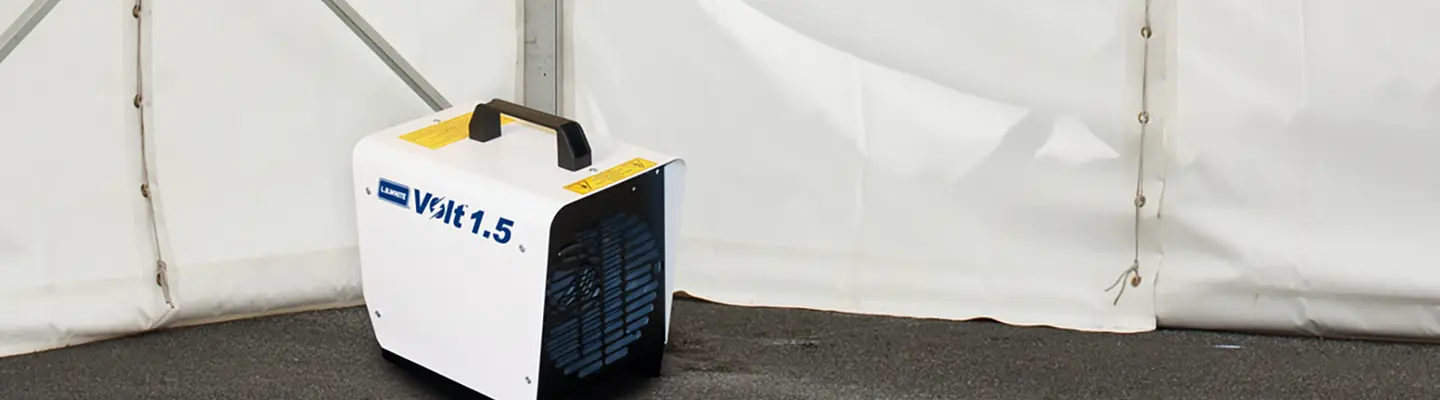
Electric heaters provide quiet, zero-emissions heat. However, running one in an event tent is not as simple as plugging it into an electrical outlet. Most electric heaters large enough to heat an event tent require a large generator to power them, which can make them very expensive to run.
The generator must be big enough to produce the high amp loads needed to create electric heat. Your rental heater vendor can provide information around proper sizing and placement.
How do I size an event tent heater?
To choose a large enough heater to keep your guests warm, you’ll need to determine how many British Thermal Units (BTUs) of heater capacity you need. Start with the two most important inputs: the square footage of the tent and how much warmer you want to make the tent air compared to the outside air.
As a very general rule, you’ll need approximately 20 BTUs per square foot, plus or minus 10 to 20 BTUs depending on the outside temperature.
Sizing a tent for an event is often far from simple, however. Factors that affect the heat/cooling load of a tent include:
- Altitude of the location
- Outside temperature
- Desired temperature
- Tent dimensions and cubic feet with a peak
- Tent material (some materials provide more insulation than others)
- Tent windows
- Number of guests
- Activity level of the guests (such as dancing vs. sitting)
A knowledgeable event tent heater rental provider can help you calculate the load and suggest event tent heaters sized for the event.
Choosing an event tent heater rental provider
Setting up the perfect event is all about paying attention to detail. Partnering with a one-stop shop for all your event equipment needs—from tent heater rentals to generators, event lights, temporary fencing and portable restrooms—can help streamline planning as well as equipment deliveries and pickups. It can also help improve onsite support.
United Rentals offers the equipment, experience and 24/7 support to help you plan an event that runs smoothly and leaves guests with only positive memories.