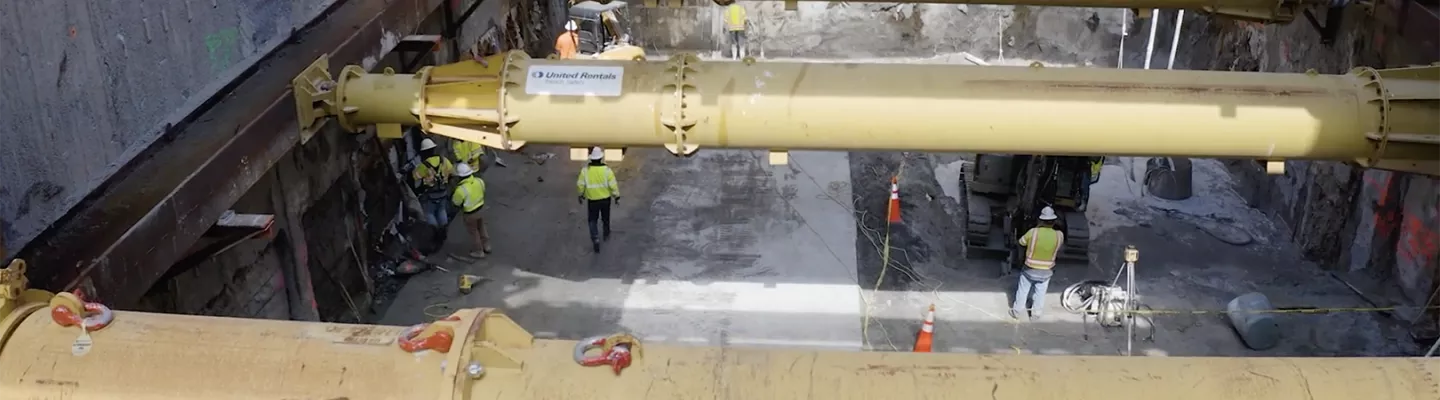
Compared to steel beam braces, high-load-capacity hydraulic braces are faster, safer and cheaper.
Article Updated on: November 12, 2026
Welding walers and chairs for steel beam excavation bracing is labor intensive and potentially dangerous. Contractors facing tight construction budgets and shortened schedules can save time and money, and protect worker safety, by renting a high-load-capacity modular hydraulic bracing system instead.
Commonly used as part of a sheet pile bracing system or paired with slurry walls or beam and lag walls, these flexible systems can support deep excavations, irregular excavations and the long excavations needed to construct clear span buildings and tunnels. For larger excavations, the braces are paired with high-load-capacity hydraulic struts.
What are the benefits of modular hydraulic bracing systems?
Hydraulic bracing systems are often ideal for fuel tank installation, heavily loaded cofferdams and excavations for deep basements and similar structures. Some of the main benefits are outlined below.
Less labor, lower costs
Excavation shoring and bracing is one of the first activities on a construction site. Saving time and reducing costs at this early stage is important to a project’s overall success. A modular hydraulic bracing system speeds the installation of bracing, allowing contractors to start work in the excavation sooner and shortening the project schedule.
These systems consist of:
- A hydraulic ram unit with 1 meter (3.28 feet) of adjustability for an exact fit
- Extension sections ranging from 3 meters (9.8 feet) to 10 meters (32.8 feet)
- Two pins to join the ram unit to the extension sections
- A single pin to connect the sections at the corners
- Chains anchored to the tops of the sheet piles or to higher-level braces to hang the system
Welding is eliminated, which saves considerable time and labor costs. Welders are spared the task of performing a hot, dangerous job inside an excavation, and business owners are spared the time and expense of welding and the bother of securing hot work permits.
Offsite assembly
The temporary equipment vendor can assemble much of the hydraulic bracing system offsite, then transport the extension sections to the jobsite in lengths that avoid the need for oversize load permits. In the meantime, the contractor can deploy their workers on other tasks, getting a jump on excavation activities.
When the extension sections arrive on site, workers can quickly pin them together to reach the required size and configuration.
Steel walers, by contrast, are too long to be welded together offsite or transported without an oversize load permit.
Fast installation and removal
Installing and removing a modular hydraulic bracing system is fast and easy. Pinning one section to another takes about 15 minutes, while welding one section of a steel waler to another can take as long as two to three hours.
In addition, the modular configuration makes it possible to install and remove the system with relatively light-duty lifting equipment.
Open, flexible configurations
High-load-capacity modular hydraulic bracing systems can achieve clear spans ranging from 3 meters (9.8 feet) to 24.2 meters (79.4 feet). Used in conjunction with high-load-capacity hydraulic struts, they can support excavations more than 30 feet long or wide.
Because the corners can be adjusted at different angles, these systems work for irregularly shaped excavations as well as rectangular excavations.
How do you design a modular hydraulic bracing system for your excavation?
The proper design of shoring systems is critical to worker safety and project success. To prevent cave-ins and other accidents, all excavation protective systems must meet the standards outlined in OSHA 1926 Subpart P.
In the case of a hydraulic bracing system, accurately calculating the load being applied and determining the working load capacity of the extension sections is paramount.
Maintain excavation safety with United Rentals
United Rentals’ Trench Engineered Systems experts pioneered the use of hydraulic shoring and bracing systems in the United States. Our team of in-house Registered Professional Engineers can perform complex load calculations and configure a hydraulic bracing system or excavation shoring and bracing system that meets the load requirements and fits the excavation plan.
With our extensive inventory of hydraulic shoring and bracing equipment and engineering expertise, United Rentals can quickly deliver customized, pre-assembled components to catapult trench projects to the next stage.