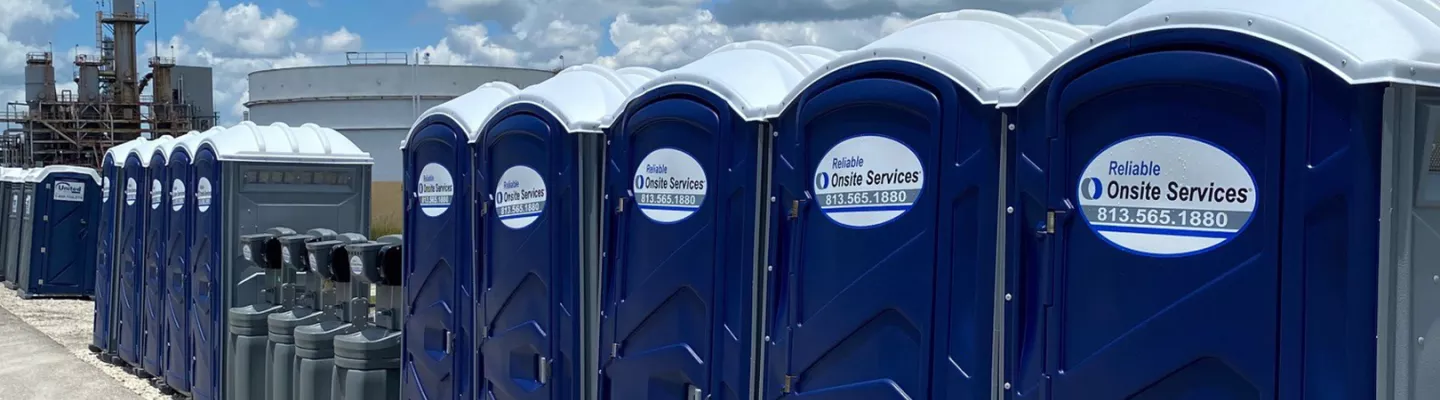
Event planners must keep accessibility in mind, since ADA porta potties are required by law at any event open to the public.
Article Updated on: November 25, 2026
If you’re planning portable toilets for your next event, you may be wondering if you need to provide handicap portable toilets, and if so, what exactly the ADA porta potty requirements are. The Americans With Disabilities Act (ADA) mandates that public facilities, including restrooms, must be accessible to people with disabilities.
When does the law apply, and what types of portable toilets should you look for? Here’s what you need to know about ADA-compliant portable toilets.
When do ADA regulations apply?
If your event is taking place in a public space, federal law requires you to provide access to an ADA-compliant portable restroom. ADA regulations for portable toilets apply to all venues, commercial facilities and state and local government facilities that are open to public use.
ADA regulations apply to all public events, including:
- Street fairs
- Music festivals
- Sporting events
- Graduations
- Trade Shows
- Private parties
- Weddings
ADA regulations do not apply to portable toilets on construction sites or other temporary facilities not intended for public use.
The law mandates that 5% of toilets within a cluster of portable restrooms be ADA compliant, with at least one accessible unit per location. They must also be marked with the International Symbol of Accessibility (blue wheelchair with braille writing).
If you’re not sure whether ADA portable toilet requirements apply to your event or venue, consult with an attorney or check with your local municipality. Local governments are responsible for enforcing ADA requirements for any venue open to the public.
What is the difference between ADA-compliant toilets and wheelchair-accessible toilets?
ADA-compliant toilets and wheelchair-accessible toilets both add accessibility for people with disabilities, but not all wheelchair toilets meet the legal ADA requirements for public events.
The main features of wheelchair-accessible toilets are larger doors, a ramped entrance and extra room for turning.
ADA-compliant porta potties also accommodate wheelchair users, but they meet stringent government standards for people with other types of disabilities. They are larger, with more floor space for 360-degree turning, and have self-closing magnetic or hinged doors.
Feature | ADA-Compliant Portable Restroom | Wheelchair-Accessible Portable Restroom |
|---|---|---|
Door width | Minimum 32 inches and self-closing door | Wider than standard restrooms but not regulated |
Stall size | At least 60 inches wide by 56 inches deep | Enough space for a 3-point turn |
Grab bars | Required; must be reinforced and securely mounted | Optional |
Ramped entrance | Required | Required |
Legal compliance | Meets ADA Standards for Accessible Design | Not guaranteed to meet legal requirements |
Required at public events | Yes, 5% of portable restrooms | No |
What are the required ADA portable toilet dimensions and features?
ADA-compliant portable restrooms range in size from single porta potty units to multiple-station restroom trailers that accommodate guests with and without accessibility needs.
We also have an ADA-compliant restroom and shower trailer that features two accessible stations with toilets, sinks, showers, grab bars and wheelchair ramps, as well as two standard stations with toilets and sinks.
The ADA Standards for Accessible Design specify the following ADA porta potty dimensions and features:
- Stall: The stall should measure at least 60 inches wide from the side walls and 56 inches deep from the back wall.
- Door: The door should have a minimum width of 32 inches. It should swing out and be self-closing.
- Floor space: Stall floors should have enough space (60-inch diameter) for a wheelchair to turn around or a t-shaped space for a three-point turn.
- Grab bars: Toilets should include reinforced grab bars for support and stability. Bars should be securely mounted and easy to grasp.
- Toilet seat: The seat should be 17 to 19 inches above the floor.
- Sinks: Sinks should be 30 inches above the floor to allow wheelchair access.
Why are ADA-compliant porta potties important for events?
ADA portable toilets ensure that people with accessibility needs can use restroom facilities with dignity and ease. By making these toilets available, you’re not only complying with the law, but you’re also creating an inclusive environment for all.
United Rentals offers a variety of portable restroom units that are verified to meet ADA accessibility standards, so you can rent with confidence for your next event.