
Let’s talk about traffic congestion. No one likes being stuck in gridlock. Not only is it tiring and monotonous, it’s also stressful – like feeling the pressure of leaving the kids languishing in after school care or being late for an important meeting or job interview.
The most obvious solution for reducing traffic congestion is to remove as many trucks from the roads as possible, and for that to happen, adopting a transport modal shift from road to rail is required. That is where Intermodal containers play a key role. These highly engineered and robust units, designed to move goods and products on rail, are gamechangers.
Because rail is the primary mode of transport for Intermodal Containers, it plays a key role in helping to lower the number of large articulated trucks on roads, as well as reducing emissions and a company’s all-important carbon footprint.
The data doesn't lie
The numbers are revealing, and highlight the key benefits of Intermodal Containers:
- Intermodal achieves up to a 60% reduction in CO2 emissions compared to truck-only transport. These reductions are greater if renewable energy integration is applied.
- Moving freight by rail is 16 times more fuel efficient than moving freight by road. This modal shift will help reduce the carbon emissions of Australia’s and New Zealand’s freight industries.
- A double-stacked train can carry the equivalent freight volume of 110 B-double trucks to significantly reduce road congestion.
Additionally, Intermodal Containers are faster, safer, more cost effective, and significantly more resilient and reliable compared to transporting goods by road over long distances. These factors are especially important for temperature-sensitive products and sectors such as agriculture, food, and medical, which require a reliable network to deliver freight before it thaws or goes off.
Having a predictable delivery time frame is something rail offers, rather than potential for trucks to be delayed by traffic congestion.
Road vs rail emissions
Let's break the data down further. The average emissions of rail transport are significantly lower compared to truck transport.
- Road Transport (via truck): Average emissions: 60-150 g CO2e per tonne-km (which varies based on truck size, load, and fuel efficiency)
- Rail Transport: Average emissions: 15-40 g CO2e per tonne-km
If these factors are applied to a long-haul route from Melbourne to Brisbane – that’s around 1,700 km – the potential emissions reduction is significant.
- Truck-only transport: Emissions 1,700 km * 100 g CO2e/tonne-km = 170,000 g CO2e per tonne
- Intermodal transport (80% rail, 20% truck):
- Rail portion: 1,360 km * 25 g CO2e/tonne-km = 34,000 g CO2e per tonne
- Truck portion: 340 km * 100 g CO2e/tonne-km = 34,000 g CO2e per tonne
- Total: 68,000 g CO2e per tonne
That’s a substantial emissions reduction of 60%.
Ongoing investment in infrastructure and moving to more efficient and “greener” locomotives are also essential for optimising emission reductions.
In Australia especially, with its large distances between major centres, the cost advantages of rail become even more pronounced. This is especially important in light of rising fuel prices and potential carbon pricing mechanisms.
Lower transportation costs have a ripple effect through the economy, potentially leading to lower consumer prices and improved competitiveness for both Australia and New Zealand exports.
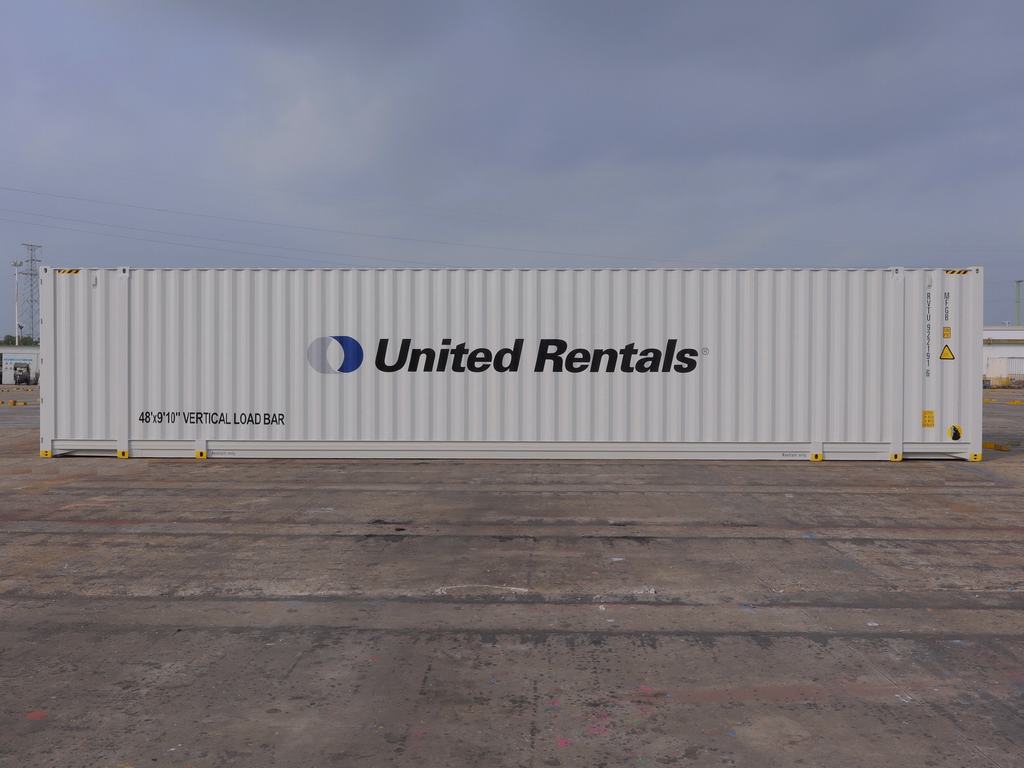
New Intermodal innovation
United Rentals has launched a product line that uses Powder Coating rather than the traditional Volatile Organic Compound (VOC) paint systems used in the container industry.
It makes United Rentals Australia the first local company to introduce a fleet of 40-foot and 48-foot powder coated Intermodal containers. Powder coating offers a lower carbon impact through:
- Near-Zero VOCs & No Hazardous Waste: Powder coatings do not require solvents and release almost no VOCs into the atmosphere compared to epoxy paints. They also eliminate hazardous wastewater residues during the disposal of liquid paint systems.
- Reducing Material Usage: Powder coating can achieve up to 95% transfer efficiency, allowing excess, un-sprayed powder to be reused. Traditional liquid systems may only transfer 60% of paint.
- Lowering Overall Energy Consumption: While powder requires energy for curing, research shows the overall process can reduce energy consumption by up to 30%.
- Enhanced Durability: Powder-coated containers have higher resistance to corrosion and damage, which can extend the lifespan of the container by up to 20 years.
Evolving to meet demand
Beyond the logistics sector, the construction and hire industries continue to evolve, especially with demand for sustainable and eco-friendly solutions.
United Rentals proactively works to reduce its carbon footprint, and with products like the solar-powered Site Hub, it helps customers do the same.
The Site Hub provides quick and efficient site set up, especially on projects when there is no or limited access to services such as power and water.
The Site Hub is a powerhouse in reducing carbon emissions and tapping into boundless energy. It is not only a self-sufficient work site solution, it helps customers reach their Net Zero targets while delivering cost-effective projects.
Research commissioned by United Rentals over the course of a year found the Site Hub reduced emissions by more than 95% and saved $25,000 over a year compared to traditional diesel-run generator sites*.
The research also found that using renewable energy to operate means the Site Hub helps customers meet their Net Zero commitments, reducing greenhouse gas emissions by more than 90% and neutralising the remaining 10% or less through offsets.
Similar to Intermodal Containers, the Site Hub and other Solar and Battery Energy Storage Systems offered by United Rentals have the power to help businesses reduce costs, supporting them to meet and exceed sustainability targets and goals, and gain that all-important competitive advantage.
*When used as per manufacturer's specification.